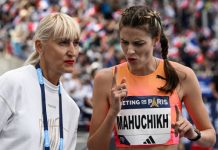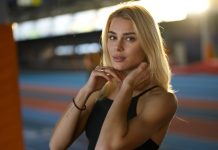
Since the launch of the Tough Athletics Awards, no edition of the “Tough Athletics” honors has passed without Yaroslava Mahuchikh claiming victory in one of the categories. Back in 2017, we first recognized the then 15-year-old high jumper after she cleared 1.92m to win the World U18 title.
Nine years later, at the Decathlon Tough Athletics Awards 2025, Mahuchikh is being celebrated as the reigning world record holder, thanks to her astonishing 2.10m clearance. The 24-year-old from Dnipro boasts two Olympic medals, seven World Championship podium finishes, and five European titles across outdoor and indoor competitions.
In 2017, Oleksii Kulivets met the young Yaroslava following her triumph at the World Youth Championships. A few days ago, they spoke again — this time after Mahuchikh’s victory at the Ukrainian Championships in Kyiv. The conversation took place as part of the special project “Decathlon Tough Athletics Awards 2025.”
On the Ukrainian Championships and Emotions in the Sector
— Let’s start with the competition. It looked tense. How did you handle it?
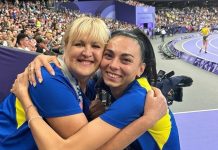
— I don’t even know… The competition was very long — we were just sitting around for almost two hours. Then the situation with Kateryna (Kateryna Tabashnyk suffered a serious injury during the Ukrainian Championships final — editor’s note) was very unsettling. We talk to each other, we worry about one another. And suddenly she’s lying on the mat, and you don’t know what to do. After that, it’s hard to refocus on your own jumps and keep smiling in the sector.
Still, I managed to clear 1.90m on my first attempt and 1.96m on my second, which gave me a bit of an advantage. Unfortunately, 2.00m and above didn’t go today — but that’s sport. I’m very happy to be back at the Ukrainian Championships and to see how much has changed compared to five years ago, when I last competed domestically in 2021 in Sumy.
Here in Kyiv, the event has reached a really high level. It’s amazing to see so many spectators who understand the sport and come to support us.
— Speaking of fans, your Japanese supporter has become a social media star himself. Does that kind of attention ever get tiring?
— Not at all. He’s very polite and never intrusive — he always asks first. When we were in Tokyo, he didn’t try to force a hug or anything like that. On the contrary, he tried not to disturb me and simply said, “I’ll be nearby, cheering.”
It’s wonderful to see such interest in Ukrainian sport across Asia. There are many fans in Japan and China — I really felt it when I traveled to Japan in 2025. It turns out I’ve had a strong fan base there since 2021. The same happened in China when I competed there in 2025 — I could truly feel the support.
— A video of you lying down between attempts went viral in Asia, with millions of views.
— Yes, especially in Japan. They have a culture where it’s completely normal to take a short rest or even nap during the workday. So they really related to that moment.
Training in Dnipro: “I Had to Wear Two Pairs of Sweatpants”
— Tell us about your offseason preparation in Dnipro. This winter was extremely difficult for Ukraine.
— My main goal was psychological recovery. Being at home is always better — your people, your atmosphere, family, friends, even my cat, who helped with recovery too.
Of course, it wasn’t easy. Training in a sports school while missiles are flying and there’s constant air raid danger is difficult. There was no heating either — like in many places. I trained wearing two pairs of warm sweatpants, two sweatshirts, and even used the blanket I normally take to competitions.
But maybe that hardens you. I really missed the home vibe — talking with coaches, seeing kids come to training sessions and feeling that you inspire them to keep working and competing.
— I reread our first interview from 2017. You said back then that your training group was like a family. Has that changed?
— We’ve become even closer. On the one hand, that’s great. On the other, it’s a bit more complicated because we’re all adults now, we’re all evolving. But we’ve known each other for so many years that we can argue and reconcile — argue and reconcile again. That’s life. In the end, we remain a strong, supportive team.
“I Still Want to Jump”: Olympic Plans and Motherhood
— I remember in 2018–2019 your coach was very protective of you. What about now?
— Back then, we were careful because we wanted to transition successfully into senior competition and peak there. That approach is paying off now. My first senior World Championships were in 2019, even though I could have competed at senior Europeans earlier. But there were youth and junior events that were important at the time.
We still monitor workload carefully. In 2025, I had many competitions in different countries — constant travel and adaptation are tough. So this year we decided to take a calmer approach: stay in Ukraine, open the season in Lviv at the Demyanyuk Memorial, compete in just one international meet in Karlsruhe, then return for the Ukrainian Championships and prepare for the main event of the season — the World Championships.
We’re not overloading the schedule. I’m 24 — still young, but at the same time, not that young anymore.
— You’re only officially in your second year as a senior.
— True, but maybe not young in terms of experience. I’ve been to two Olympic Games and set a world record. Still, there’s plenty of work ahead.
— What about career longevity?
— We’ve followed the philosophy of prolonging the career since youth level. I want to compete at least at two more Olympic Games — in Los Angeles and in Australia. Maybe even in 2036. But health will decide. Ideally, I want to finish while still performing at a high level — not when I’m placing tenth. Finding that balance is important.
— Iryna Herashchenko returned to competition after maternity leave at the age of 30 and is delivering strong results. Have you already thought about when you would like to become a mother?
— Not in the near future — definitely not before Los Angeles. I have a niece, and my close friends have children, so that’s enough for now. I lean more toward the European approach: first live, build your life, and then have children.
Iryna Herashchenko is amazing — she and her husband wanted that, and it was their joint decision. But me? I still want to jump.
“I Have a Long-Standing Position Regarding Bubka”
— You’ve spoken before about your stance on Bubka. How do you comment now on Vladyslav Heraskevych’s recent actions?
— My position hasn’t changed. As for Vladyslav Heraskevych, he probably united Ukrainians once again. We felt that sense of unity and support.
It’s deeply unfair when athletes are not allowed to honor those who were killed and it’s labeled a “political gesture.” This is our memory of people who gave their lives. Among them were people I knew personally — track and field athlete Volodymyr Androshchuk and boxer Maksym Halinichev, who competed alongside me at the Youth Olympic Games. I remember watching his bouts.
It’s painful when athletes from other countries are allowed to display photos or even wear a Russian flag on their helmet, while Ukrainians are denied the right to carry portraits in memory of the fallen. That’s when you truly feel the injustice.
I am genuinely grateful to Vladyslav Heraskevych for his stance. That is the position of a true Ukrainian.
Decathlon supports the heroes of Tough Athletics because we believe professional sport inspires, and accessible sport changes lives. We create equipment that transforms your first attempts into confident victories. Decathlon. We create sport for everyone.
Yaroslava Mahuchikh Opens 2026 Season With World-Leading 2.03m Jump in Lviv